‏إظهار الرسائل ذات التسميات Connectivity. إظهار كافة الرسائل

الخميس، 31 أغسطس 2017

Increase Broadband Speed Using Simple Tweak

 
A Simple Tweak (XP Pro only) which will increase your Broadband Speed.
Make sure you Log on as Administrator, not as a user with Administrator privileges.
Follow the steps as given below-
1) Click on Start Button.
2) Select Run From Start Menu.
3) Type gpedit.msc
4) Expand the [Administrative Templates] branch.
5) Then Expand the [Network] branch.
6) Highlight(Select by Single Click) [QoS Packet Scheduler]
7) Double-click [Limit Reservable Bandwidth] (Available in Right Side Panel)
8) Check(Select By Single Click on it) [Enabled]
9) Change [Bandwidth limit %] to 0 %
10) Click [OK] Button.
11) Restart Your PC.
12) Now Check Your Broadband Speed.


Source:- http://www.insecure.in/broadband_trick.asp

Create Folders And Files With NO! Name

This trick will allow you to create files and folders without any name.
Just follow the steps as given below :-
1) Select any file or folder.
2) Right click on it, select 'Rename' or simply press 'F2'.
3) Press and hold the 'Alt' key. While holding the Alt key, type numbers '0160' from the numpad.
Note :- Type the numbers '0160' from the numpad, that is, the numbers present on the right side of the keyboard.
Don’t type the numbers which are present on top of the character keys.
4) Press Enter and the nameless file or folder will be created.
Reason :- The file or folder that seems nameless is actually named with a single space.
But what if you want to create another nameless file or folder in the same directory ?
For this you will have to rename the file with 2 spaces.
Just follow the steps given below :-
1) Select file, Press 'F2'.
2) Hold 'Alt' key and type '0160' from the numpad.
3) Release the 'Alt' key. Now without doing anything else, again hold 'Alt' key and type '0160'.
4) Press 'Enter' and you will have second nameless file in the same directory.
5) Repeat step 3 to create as many nameless files or folders in the same directory.
(We have a problem with deleting these folders, to do so, start your computer in 'Safe Mode' and delete it from there.)


Source:- http://www.insecure.in/noname_trick.asp

Chat with Friends through ms dos Command Prompt

1) All you need is your friend's IP Address and your Command Prompt.

2) Open Notepad and write this code as it is.....!

@echo off
:A
Cls
echo MESSENGER
set /p n=User:
set /p m=Message:
net send %n% %m%
Pause
Goto A

3) Now save this as "Messenger.Bat".
4) Open Command Prompt.
5) Drag this file (.bat file) over to Command Prompt and press Enter.
6) You would then see something like this:

7) Now, type the IP Address of the computer you want to contact and press enter
You will see something like this:

8) Now all you need to do is type your message and press Enter.
Start Chatting.......!

Source:- http://www.insecure.in/cmd_chat_trick.asp

الأربعاء، 30 أغسطس 2017

Reveal *****(Asterisk) Passwords Using Javascript

Want to Reveal the Passwords Hidden Behind Asterisk (****) ?

Follow the steps given below-

1) Open the Login Page of any website. (eg. http://mail.yahoo.com)

2) Type your 'Username' and 'Password'.

3) Copy and paste the JavaScript code given below into your browser's address bar and press 'Enter'.

javascript: alert(document.getElementById('Passwd').value);

4) As soon as you press 'Enter', A window pops up showing Password typed by you..!

Note :- This trick may not be working with firefox.


Source:- http://www.insecure.in/reveal_pass_trick.asp

The Ethical Hacker

Welcome to the unique confluence of hackers , crackers and security professionals on the world wide web.


This is your complete resource for internet security and ethical hacking.


 -: The Ethical Hacker :-hack
Most people think that hackers are computer criminals.
They fail to recognize the fact that criminals and hackers are two totally different things.
Media is responsible for this.
Hackers in reality are actually good and extremely intelligent people who by using their knowledge in a constructive manner help organizations, companies, government, etc. to secure documents and secret information on the internet.

Source:- http://www.insecure.in/

Windows-XP Password Cracking

Here we use the tool "Cain and Abel" for cracking passwords of any local user/administrator.


First download cain and abel from "http://www.oxid.it/cain.html" and install it on your system.


Make sure that you have disabled the antivirus/firewall running on your system before installing and throughout this process.


Two most effective techniques used here are "Brute-Force" and "Cryptanalysis".
Brute-Force:- As this techniques takes more time to complete, the attacker prefer this technique only when there is a hope that the password contain same type of characters or may be two. i.e only loweralpha, only alpha, only numeric or may be loweralpha-numeric, also it should contain less than 7 characters. Otherwise it takes more time to crack password, which may be the mixture of all types of characters along with special symbols.


The step-by-step explaination for this technique is given below-


1) Open the tool "Cain and Abel"  

2) Go into the category "Cracker"      it displays all sub-categories under "Cracker" in left panel.

3) Select "LM & NTLM Hashes" from left panel and then click on      symbol, you will be greeted by a window as shown.

4) Check "import hashes from local system" and then click "Next". This shows all the active accounts on local system like administrator, guest, etc. along with LM and NT hashed values of their respective passwords, as shown below.

5) Right clicking on any username shows all available options using which we can crack it's password.

6) Here we select "Brute-Force Attack" and then "NTLM Hashes", since windows uses NTLM hashes to store local users' passwords.
7) You will be greeted by a window where you can modify properties for brute-force attack such as password length, character set, etc.

8) Click on "Start" button.
9) On completion it will reveal the exact password.


Cryptanalisys :- Basically, Cryptanalisys means Operations performed in converting encrypted messages to plain text without initial knowledge of the crypto-algorithm and/or key employed in the encryption.


This is the fastest technique of password cracking possible due to "Rainbow Tables".


A rainbow table is a file that is used to lookup an unknown plaintext from a known hash for an algorithm that does not usually permit this operation.


Steps 1 to 4 i.e upto importing hashes from local system, are similar to previous technique (i.e brute-force). The steps coming after that are as follows-


5) Here, select "cryptanalisys attack" then "NTLM hashes" and then select "via rainbow tables". Here we can choose either OphCrack or RainbowCrack formats of tables. The rainbow tables are available free to download on internet.


Due to large file size of rainbow tables (350MB - 3GB); instead of downloading we can also create at own just by downloading rainbow table generator (winrtgen.zip of 181KB) free download at "http://www.oxid.it/downloads/winrtgen.zip"

6) Click on "Add Table"

7) Browse for the location of rainbow table on your system, select proper table and click "open".

8) Select the loaded table and then click on "Start" button.

9) On completetion it will show the exact password.


To learn windows password cracking techniques properly, one must understand "LM" & "NTLM" algorithms, SAM File, Dumping NTLM hashes from local SAM, Rainbow Tables, etc.......!

Source:- http://www.insecure.in/winxp_passcrack.asp

Password Hacking

Password cracking is the process of recovering secret passwords from data that has been stored in or transmitted by a computer system. A common approach is to repeatedly try guesses for the password.


Most passwords can be cracked by using following techniques :


1) Hashing :- Here we will refer to the one way function (which may be either an encryption function or cryptographic hash) employed as a hash and its output as a hashed password.
If a system uses a reversible function to obscure stored passwords, exploiting that weakness can recover even 'well-chosen' passwords.
One example is the LM hash that Microsoft Windows uses by default to store user passwords that are less than 15 characters in length.
LM hash breaks the password into two 7-character fields which are then hashed separately, allowing each half to be attacked separately.


Hash functions like SHA-512, SHA-1, and MD5 are considered impossible to invert when used correctly.

2) Guessing :- Many passwords can be guessed either by humans or by sophisticated cracking programs armed with dictionaries (dictionary based) and the user's personal information.

Not surprisingly, many users choose weak passwords, usually one related to themselves in some way. Repeated research over some 40 years has demonstrated that around 40% of user-chosen passwords are readily guessable by programs. Examples of insecure choices include:

* blank (none)
* the word "password", "passcode", "admin" and their derivatives
* the user's name or login name
* the name of their significant other or another person (loved one)
* their birthplace or date of birth
* a pet's name
* a dictionary word in any language
* automobile licence plate number
* a row of letters from a standard keyboard layout (eg, the qwerty keyboard -- qwerty itself, asdf, or qwertyuiop)
* a simple modification of one of the preceding, such as suffixing a digit or reversing the order of the letters.
and so on....

In one survery of MySpace passwords which had been phished, 3.8 percent of passwords were a single word found in a dictionary, and another 12 percent were a word plus a final digit; two-thirds of the time that digit was.


A password containing both uppercase &  lowercase characters, numbers and special characters too; is a strong password and can never be guessed.

Check Your Password Strength

3) Default Passwords :- A moderately high number of local and online applications have inbuilt default passwords that have been configured by programmers during development stages of software. There are lots of applications running on the internet on which default passwords are enabled. So, it is quite easy for an attacker to enter default password and gain access to sensitive information. A list containing default passwords of some of the most popular applications is available on the internet.


Always disable or change the applications' (both online and offline) default username-password pairs.

4) Brute Force :- If all other techniques failed, then attackers uses brute force password cracking technique. Here an automatic tool is used which tries all possible combinations of available keys on the keyboard. As soon as correct password is reached it displays on the screen.This techniques takes extremely long time to complete, but password will surely cracked.


Long is the password, large is the time taken to brute force it.

5) Phishing :- This is the most effective and easily executable password cracking technique which is generally used to crack the passwords of e-mail accounts, and all those accounts where secret information or sensitive personal information is stored by user such as social networking websites, matrimonial websites, etc.
Phishing is a technique in which the attacker creates the fake login screen and send it to the victim, hoping that the victim gets fooled into entering the account username and password. As soon as victim click on "enter" or "login" login button this information reaches to the attacker using scripts or online form processors while the user(victim) is redirected to home page of e-mail service provider.


Never give reply to the messages which are demanding for your username-password, urging to be e-mail service provider.

It is possible to try to obtain the passwords through other different methods, such as social engineering, wiretapping, keystroke logging, login spoofing, dumpster diving, phishing, shoulder surfing, timing attack, acoustic cryptanalysis, using a Trojan Horse or virus, identity management system attacks (such as abuse of Self-service password reset) and compromising host security.
However, cracking usually designates a guessing attack.


Source:- http://www.insecure.in/password_hacking.asp

Network Hacking

Network Hacking is generally means gathering information about domain by using tools like Telnet, NslookUp, Ping, Tracert, Netstat, etc.


It also includes OS Fingerprinting, Port Scaning and Port Surfing using various tools.


Ping :- Ping is part of ICMP (Internet Control Message Protocol) which is used to troubleshoot TCP/IP networks. So, Ping is basically a command that allows you to check whether the host is alive or not.


To ping a particular host the syntax is (at command prompt)--

c:/>ping hostname.com

example:- c:/>ping www.google.com

Various attributes used with 'Ping' command and their usage can be viewed by just typing c:/>ping at the command prompt.


Netstat :- It displays protocol statistics and current TCP/IP network connections. i.e. local address, remote address, port number, etc.
It's syntax is (at command prompt)--

c:/>netstat -n

Telnet :- Telnet is a program which runs on TCP/IP. Using it we can connect to the remote computer on particular port. When connected it grabs the daemon running on that port.
The basic syntax of Telnet is (at command prompt)--

c:/>telnet hostname.com

By default telnet connects to port 23 of remote computer.
So, the complete syntax is-

c:/>telnet www.hostname.com port

example:- c:/>telnet www.yahoo.com 21 or c:/>telnet 192.168.0.5 21


Tracert :- It is used to trace out the route taken by the certain information i.e. data packets from source to destination.
It's syntax is (at command prompt)--

c:/>tracert www.hostname.com

example:- c:/>tracert www.insecure.in

Here "*    *    *    Request timed out." indicates that firewall installed on that system block the request and hence we can't obtain it's IP address.
various attributes used with tracert command and their usage can be viewed by just typing c:/>tracert at the command prompt.
The information obtained by using tracert command can be further used to find out exact operating system running on target system.


Source:- http://www.insecure.in/network_hacking.asp

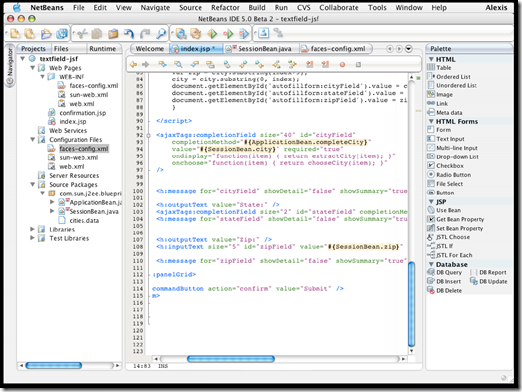
NetBeans

NetBeans - Development Simplified

A free, open-source Integrated Development Environment for software developers. You get all the tools you need to create professional desktop, enterprise, web, and mobile applications with the Java language, C/C++, and even dynamic languages such as PHP, JavaScript, Groovy, and Ruby. NetBeans IDE is easy to install and use straight out of the box and runs on many platforms including Windows, Linux, Mac OS X and Solaris.

NetBeans logo                           NB DVD Order logo

The NetBeans IDE 6.5 provides several new features and enhancements, such as rich PHP, JavaScript and Ajax editing features, improved support for using the Hibernate web framework and the Java Persistence API, and tighter GlassFish v3 and MySQL integration.

NetBeans01

NetBeans Supported Technologies

Ajax | C/C++ | Databases | Debugger | Desktop | Editor | Groovy | GUI Builder | Java EE | JavaFX | Java ME | Java SE | JavaScript | Mobile | PHP | Profiler | Python | Refactor | REST | Rich Client Platform | Ruby | SOA | SOAP | UML | Web | WSDL | XML

download

Download Java SE and NetBeans Cobundle (JDK 6u13 and NB 6.5.1) for Windows, Multi-language          

- JMD Computer

* if Link is Broken, fill free form click here with Link Details.

Source:- http://www.netbeans.org/features/    or    http://www.netbeans.org/

الثلاثاء، 29 أغسطس 2017

Modix HD3510: Fully Adequate DVD Player Replacement

At first glance, the white box of the Modix player looks like a normal external hard drive case. On the front is a large display and lots of function buttons, while the A/V and USB ports can be found on the back, where you can also attach an external power supply. Once you turn on the device, a menu structure will appear on the hard-to-read display. You can navigate either with the remote control or using the many buttons on the front.

Package information , Package Contents


The player can be controlled without a remote control, using the buttons

The remote control is pleasant to hold

Some buttons on the remote control have no functions

Source:- http://www.tomshardware.com/reviews/hard-disk-drive-video-players-hit-mainstream,1107-10.html

Player Setup: Not Much Of Use Here

Lots of setup options? Don't be fooled by its looks.

While the player's preference list contains all the absolutely critical functions, it dispenses completely with any instructions or explanations. Users are left scratching their heads over mysterious acronyms and jargon in both English and Chinese. The manual also lacks clear answers regarding what kinds of effects a modification might produce.

Selecting the TV standard

Two language versions are available

The on-screen text can be deactivated

Resetting the screen

File sorting

(De-)activating the screensaver

Source:- http://www.tomshardware.com/reviews/hard-disk-drive-video-players-hit-mainstream,1107-8.html

Setup Menu: Audio And Video

Not needed, since the remote has buttons that do the same things

Setup Menu: Slideshow

Image display settings


Source:- http://www.tomshardware.com/reviews/hard-disk-drive-video-players-hit-mainstream,1107-7.html

Not Many Setting Options Either

The main menu on the setup page

To get to the setup menu you have to push a button on the remote control. You'll search in vain for many menu options to configure, though. The menus are superfluously large, making it seem as if you have a lot of options to set, but you really don't.

Setup Menus: Photo Settings

Slideshow setting options

Source:- http://www.tomshardware.com/reviews/hard-disk-drive-video-players-hit-mainstream,1107-6.html